I love horror comics.
Well, let me rephrase that. I love horror comics when they're done right.
Sadly, Ghosts number 51 does not fit into that category.
Published in late 1976 (officially dated January-February 1977), this issue of DC Comics' long-running horror anthology has a great cover that promises some excellent Bicentennial comics action. The cover by Ernie Chua advertises a story about the "Haunting Spirits of '76" -- so this is bound to be a great Revolutionary War-themed ghost story, right?
Not so fast. That title actually belongs to a little three-page story in the middle of this comic. Heck, calling this a "story" is being overly generous. It's actually just a laundry list of supposedly haunted sites in Brooklyn dating back to the era of the late Eighteenth Century.
Oh, sure, it starts well, mentioning (and showing) the ghost of General William Howe, who led the British forces during the War of Independence and who supposedly still haunts a house on 33rd Street. Here he is, in all his spooky glory:
A story starring a ghostly General Howe would have been great, right? Nah, that's dropped almost immediately. The second half of this page switches quickly to a discussion of someone else seeing a couple of sea serpents.
Yes, sea serpents. In Brooklyn. Again, that would have made a hell of a story. Again, it's recounted in two simple panels and then forgotten.
After the ghost and sea serpents, page two of this little travelogue switches to a tale of a mean sea captain, followed by a couple of details about a British Navy vessel that supposedly locked some rebels up in its hold. Finally, the comic resolves with a four-panel recounting of a guy named William Axtell, a Tory sympathizer who (the comic claims) locked up a bunch of patriotic revolutionary women to starve in the basement of his house. (There really is a supposed Axtell haunting, but what we know about the true story is actually much creepier than this little blurb would lead you to believe.)
Ghosts doesn't credit the creators of this weak little three-pager. The Grand Comics Database identifies the art as being by John Calnan and Tex Blaisdell, but the writer remains a mystery. Perhaps he's a ghost as well.
The rest of this particular issue is a little bit better. It opens with a tale of Pancho Villa (whose ghost seeks his disembodied head) and closes with a third story about a dead scientists, a typewriter and an atomic bomb. Not bad, but hardly classics.
Horror comics of the 1970s were pretty toothless beasts, de-fanged by the Comics Code Authority, which wouldn't let them do anything remotely interesting. Ghosts issue 51 is a pretty sad example of how that history of self-censorship haunted the comic-book field for decades.
Friday, June 3, 2016
Friday, May 27, 2016
How Archie Comics Celebrated the Bicentennial (part 2)
Some comic books started their Bicentennial stories a bit early. Here's one of the earliest I've found, issue 36 of the awkwardly titled Archie's TV Laugh-Out. Officially dated December 1975 (which means it probably shipped to newsstands a few months before that), you'd never know this is a Bicentennial comic from the cover, which makes fun of 1974's "The Towering Inferno":
But opening the cover reveals nothing towering, burning or remotely inferno-like. Instead we get a great five-page story called "Bicentennial Banter," in which we find Archie and the gang preparing for their roles in a Bicentennial costume pageant.
Of course, Archie and Reggie have to spend the beginning of the story making fun of Jughead and arguing over who will play George Washington (Reggie wins because his dad bought the costumes). After that rather standard Archie-style interplay, though, things gets really interesting. Betty, Veronica and the other female "gang" members show up and ask about the pageant's roles for women. Archie, incredulous, asks, "Female parts? What female parts?"
Reggie quickly offers up Betsey Ross as an answer, but that's not enough (and way too easy). In response, the women spend the next page quickly listing several important women from the Revolutionary War, as well as the essential roles all women took on during the era. Check it out below:
Kids reading this back in 1975 probably had to run to the encyclopedia to find out more about these women. For me, reading this story in 2016 sent me instantly to the Google machine to look up names like Sally St. Clair and Lydia Darragh (whose name is actually misspelled in the comic). Wow. What a great little history lesson this five-page comic turns out to be. As far as I'm concerned, it's a minor classic. Archie Comics itself must agree -- they reprinted the tale in the book Archie Americana: Best of the Seventies.
I'd love to find out who wrote and drew this story. As with everything Archie published back then, it lacks creator credits. Even the Grand Comics Database (an essential reference) hasn't catalogued the writer or artist yet. That's a shame. If anyone out there knows, please chime in.
The rest of this issue doesn't have any Bicentennial content, but it's all pretty good. There's a nice mix of stories and one-page gags about Sabrina, Archie, Mr. Lodge, and a few other Archie characters. The highlight is probably a Josie story about littering -- a nice tie-in to the "keep American beautiful" campaign that was still in full swing in the mid-seventies.
I'll return to Archie's TV Laugh-Out in the near future, as the title actually contained a huge number of Bicentennial stories throughout 1976, more (as far as I can tell) than any comic except Captain America. Who knew TV laughing was so patriotic?
But opening the cover reveals nothing towering, burning or remotely inferno-like. Instead we get a great five-page story called "Bicentennial Banter," in which we find Archie and the gang preparing for their roles in a Bicentennial costume pageant.
Of course, Archie and Reggie have to spend the beginning of the story making fun of Jughead and arguing over who will play George Washington (Reggie wins because his dad bought the costumes). After that rather standard Archie-style interplay, though, things gets really interesting. Betty, Veronica and the other female "gang" members show up and ask about the pageant's roles for women. Archie, incredulous, asks, "Female parts? What female parts?"
Reggie quickly offers up Betsey Ross as an answer, but that's not enough (and way too easy). In response, the women spend the next page quickly listing several important women from the Revolutionary War, as well as the essential roles all women took on during the era. Check it out below:
![]() |
| Click to view full-size |
I'd love to find out who wrote and drew this story. As with everything Archie published back then, it lacks creator credits. Even the Grand Comics Database (an essential reference) hasn't catalogued the writer or artist yet. That's a shame. If anyone out there knows, please chime in.
The rest of this issue doesn't have any Bicentennial content, but it's all pretty good. There's a nice mix of stories and one-page gags about Sabrina, Archie, Mr. Lodge, and a few other Archie characters. The highlight is probably a Josie story about littering -- a nice tie-in to the "keep American beautiful" campaign that was still in full swing in the mid-seventies.
I'll return to Archie's TV Laugh-Out in the near future, as the title actually contained a huge number of Bicentennial stories throughout 1976, more (as far as I can tell) than any comic except Captain America. Who knew TV laughing was so patriotic?
Friday, May 20, 2016
How Blondie & Dagwood Celebrated the Bicentennial
Blondie -- a comic strip that's not all that far away from celebrating its own centennial -- made a big deal out of the Bicentennial in 1976.
Over the course of several days, writer Dean Young and artist Jim Raymond put ole' Dagwood through his paces as he and neighbor Herb try to put up a flagpole in time for the July 4th celebration.
Of course, things didn't go so well.
Here are a couple of strips from the sequence (note how some newspapers were still crediting the feature to creator Chic Young, who died in 1973), ending with the big Fourth of July blowout.
How the heck did Dagwood manage to avoid crippling himself all of these years? Does he have some sort of Wolverine-esque healing factor? Is that the key to the strip's longevity?
Unfortunately, these scans really show the weakness of newspaper archives in capturing artwork of any kind, but especially for daily and Sunday comic strips. I'll keep my eye out for better reproductions in the future, but for now, let's salute the Bicentennial and Dagwood Bumstead's nigh-immortality.
Over the course of several days, writer Dean Young and artist Jim Raymond put ole' Dagwood through his paces as he and neighbor Herb try to put up a flagpole in time for the July 4th celebration.
Of course, things didn't go so well.
Here are a couple of strips from the sequence (note how some newspapers were still crediting the feature to creator Chic Young, who died in 1973), ending with the big Fourth of July blowout.
How the heck did Dagwood manage to avoid crippling himself all of these years? Does he have some sort of Wolverine-esque healing factor? Is that the key to the strip's longevity?
Unfortunately, these scans really show the weakness of newspaper archives in capturing artwork of any kind, but especially for daily and Sunday comic strips. I'll keep my eye out for better reproductions in the future, but for now, let's salute the Bicentennial and Dagwood Bumstead's nigh-immortality.
Friday, May 13, 2016
How Broom Hilda celebrated the Bicentennial
I always loved the Broom Hilda comic strip. Oh, sure, like any daily strip it can be a bit repetitive, but Russell Myers has a great line and draws some of the best trees and landscapes (not to mention monsters) in the business.
I don't recall Broom Hilda getting all that topical very often, so I'm actually a bit surprised by this strip from Sunday, July 4, 1976. At first glance it just appears to be the cast wishing readers a happy Bicentennial (all while standing in front of a wind-flapped American flag), but there's some cynicism in the few words that we have: "Folks, until a better place comes along, let's be very kind to our wonderful United States of America!"
I think ties in pretty well to the times. The more I read about 1976, the more I realize it wasn't the happiest year. Bicentennial celebrations sometimes tried to brush that under the rug or wrap it in the flag, but others acknowledged it. Some took a totally cynical turn, while others pointed it out and said "let's try to move on." This seems to be a classic example of the last of those three models.
Some interesting context: The Broom Hilda strip was only a few years old by this point, but it must have taken off incredibly quickly. The year 1976 saw no less than four Broom Hilda books published. Three more followed in 1977. That's pretty incredible. I remember having a few of the Scholastic volumes when I was a kid, but I don't recall them carrying the Sunday strips, so I wonder if this Bicentennial strip was ever reprinted in 76, 77, or later.
Interestingly, there does not to be any current Broom Hilda reprint program. That's a shame. In preparation for writing this Bicentennial Comics entry, I took some time to revisit Broom Hilda strips both new and old. They can be a lot of fun. I think a "best of" book would be quite welcome on my shelves. Hint, hint.
UPDATE:
Here's another scan of this strip from a different newspaper. Note how the first paper chopped up the panels and ran them in a way that totally messed with the way the flag flows (quite beautifully) through the four panels in the version below. This kind of thing must really drive strip cartoonists crazy.
I don't recall Broom Hilda getting all that topical very often, so I'm actually a bit surprised by this strip from Sunday, July 4, 1976. At first glance it just appears to be the cast wishing readers a happy Bicentennial (all while standing in front of a wind-flapped American flag), but there's some cynicism in the few words that we have: "Folks, until a better place comes along, let's be very kind to our wonderful United States of America!"
Some interesting context: The Broom Hilda strip was only a few years old by this point, but it must have taken off incredibly quickly. The year 1976 saw no less than four Broom Hilda books published. Three more followed in 1977. That's pretty incredible. I remember having a few of the Scholastic volumes when I was a kid, but I don't recall them carrying the Sunday strips, so I wonder if this Bicentennial strip was ever reprinted in 76, 77, or later.
Interestingly, there does not to be any current Broom Hilda reprint program. That's a shame. In preparation for writing this Bicentennial Comics entry, I took some time to revisit Broom Hilda strips both new and old. They can be a lot of fun. I think a "best of" book would be quite welcome on my shelves. Hint, hint.
UPDATE:
Here's another scan of this strip from a different newspaper. Note how the first paper chopped up the panels and ran them in a way that totally messed with the way the flag flows (quite beautifully) through the four panels in the version below. This kind of thing must really drive strip cartoonists crazy.
Friday, May 6, 2016
How Bugs Bunny celebrated the Bicentennial (part 1)
Bugs Bunny may be gray and white in the cartoons but he had a red, white and blue streak around the time of the Bicentennial.
Of course, you can't see any of those colors in this black-and-white microfiche copy of the "Bugs Bunny" comic strip that ran on Sunday, July 4, 1976, but them's the breaks. What you do see, however, is a pretty good strip by artist Ralph Heimdahl and writer Al Stoffel in which (typical of many other strips that month) the classic Warner Brothers characters dream themselves into a key point in American history:
Heimdahl drew the Bugs Bunny comic strip for about 30 years, making him one of the longest-running rabbit artists. The strip doesn't seem to really run true to the characters from animation, but it's still some darned fine cartooning that (as far as I can tell) has never been collected in book form.
By the way Warner Brothers -- like a lot of other companies -- merchandised the heck out of their characters throughout the Bicentennial year. I've seen Bugs Bunny Bicentennial pins, hats, patches and even a belt buckle. I'm sure I've just scratched the surface as far as all of that's concerned. Expect a deeper post about that in the months ahead.
Of course, you can't see any of those colors in this black-and-white microfiche copy of the "Bugs Bunny" comic strip that ran on Sunday, July 4, 1976, but them's the breaks. What you do see, however, is a pretty good strip by artist Ralph Heimdahl and writer Al Stoffel in which (typical of many other strips that month) the classic Warner Brothers characters dream themselves into a key point in American history:
Heimdahl drew the Bugs Bunny comic strip for about 30 years, making him one of the longest-running rabbit artists. The strip doesn't seem to really run true to the characters from animation, but it's still some darned fine cartooning that (as far as I can tell) has never been collected in book form.
By the way Warner Brothers -- like a lot of other companies -- merchandised the heck out of their characters throughout the Bicentennial year. I've seen Bugs Bunny Bicentennial pins, hats, patches and even a belt buckle. I'm sure I've just scratched the surface as far as all of that's concerned. Expect a deeper post about that in the months ahead.
Sunday, May 1, 2016
How crossword puzzles celebrated the Bicentennial
My research into the comics of the Bicentennial has taken a few odd turns lately. You can expect to read more about them soon. Until then, though, here's something else that popped up while I was looking for something else: an amazing full-page Bicentennial-themed crossword from the Lakeland Ledger that ran on July 4, 1976:
This may not be comics exactly, but I like how the puzzle took the theme of the day, really ran with it, and turned it into something visual.
This probably appeared in a lot of papers around the time of the Bicentennial, and I'm sure there were other puzzles that used 1776 as its theme throughout the year. I may try to dig more of those up. For now, though, this is a nice piece of history that I imagine few have seen since it first appeared nearly 30 years ago.
Can't quite make out the detail in that? Well, neither can I (and I haven't been able to get a great scan of the entire page), but here's a slice that shows off some of the clues:
This may not be comics exactly, but I like how the puzzle took the theme of the day, really ran with it, and turned it into something visual.
This probably appeared in a lot of papers around the time of the Bicentennial, and I'm sure there were other puzzles that used 1776 as its theme throughout the year. I may try to dig more of those up. For now, though, this is a nice piece of history that I imagine few have seen since it first appeared nearly 30 years ago.
Monday, February 8, 2016
A Bicentennial Obscurity: "200 Years Ago Today"
My journey to uncover the comic books and comic strips of the Bicentennial has taken me down some odd paths since the last time I posted here. Each bit of research unveils something new, something interesting, and something that required a lot more exploration.
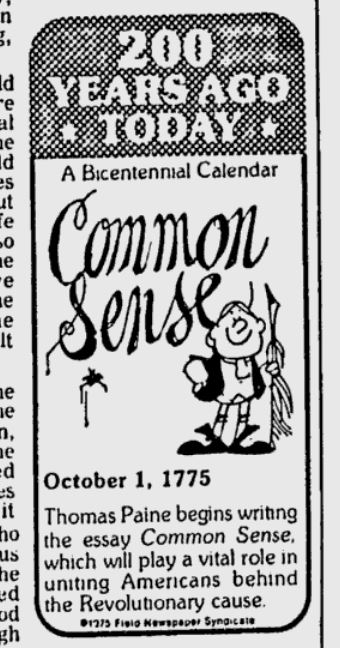
Here's one such oddity. For a couple of years, ranging through most of 1975 and 1976, the Field Syndicate distributed a tiny comics panel called "200 Years Ago Today: A Bicentennial Calendar" to newspapers around the country. This single-panel cartoon contained a fairly simple drawing and a few words of text about what happened on that date two centuries earlier, often to comedic effect. Each panel was the width of a newspaper column, allowing editors to place it wherever they wanted, pretty much as filler, often on the editorial pages, but just as often scattered in random locations throughout the paper.
I've found a few dozen examples of this strip, dating as early as June1975 and running as late as October 1976. Oddly enough, I have yet to find the cartoon for July 4, 1976, even in any of the papers that ran it.
There are no credits on any of these strips, but Allan Holtz, who runs the excellent website Stripper's Guide, tells me "the art is almost certainly by Ben Templeton." Templeton not only created one of my all-time favorite comic strips. "Motley's Crew," he also co-created another Bicentennial comic strip called "Yankee Doodles." Holtz wrote about "Yankee Doodles" here, and I'll be digging into it in the coming months. "I guess Ben was getting some extra use out of all his period drawings by signing on to a second feature," Holtz told me.
I haven't been able to track down contact information for Templeton to verify any of this, but I did reach out to King Features Syndicate, which absorbed the Field syndicate a few decades ago. The reply, from director of publicity Claudia Smith, revealed little: "I checked with our Archivist and, unfortunately, we are not able to help very much. When we absorbed NAS in the 1980s, not all the old Field features were included, and no files were saved." They couldn't even verify who owned the copyright on "200 Years Ago Today."
It seems unlikely that this material will ever enjoy a decent reprint effort, so here are many of the examples of this Bicentennial obscurity that I have been able to find so far. Enjoy!
Here's one such oddity. For a couple of years, ranging through most of 1975 and 1976, the Field Syndicate distributed a tiny comics panel called "200 Years Ago Today: A Bicentennial Calendar" to newspapers around the country. This single-panel cartoon contained a fairly simple drawing and a few words of text about what happened on that date two centuries earlier, often to comedic effect. Each panel was the width of a newspaper column, allowing editors to place it wherever they wanted, pretty much as filler, often on the editorial pages, but just as often scattered in random locations throughout the paper.
I've found a few dozen examples of this strip, dating as early as June1975 and running as late as October 1976. Oddly enough, I have yet to find the cartoon for July 4, 1976, even in any of the papers that ran it.
There are no credits on any of these strips, but Allan Holtz, who runs the excellent website Stripper's Guide, tells me "the art is almost certainly by Ben Templeton." Templeton not only created one of my all-time favorite comic strips. "Motley's Crew," he also co-created another Bicentennial comic strip called "Yankee Doodles." Holtz wrote about "Yankee Doodles" here, and I'll be digging into it in the coming months. "I guess Ben was getting some extra use out of all his period drawings by signing on to a second feature," Holtz told me.
I haven't been able to track down contact information for Templeton to verify any of this, but I did reach out to King Features Syndicate, which absorbed the Field syndicate a few decades ago. The reply, from director of publicity Claudia Smith, revealed little: "I checked with our Archivist and, unfortunately, we are not able to help very much. When we absorbed NAS in the 1980s, not all the old Field features were included, and no files were saved." They couldn't even verify who owned the copyright on "200 Years Ago Today."
It seems unlikely that this material will ever enjoy a decent reprint effort, so here are many of the examples of this Bicentennial obscurity that I have been able to find so far. Enjoy!
Subscribe to:
Posts (Atom)