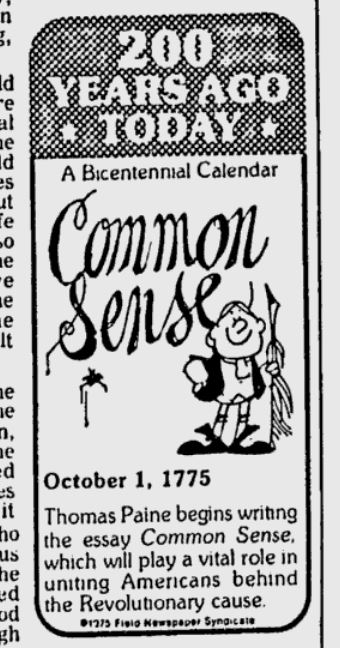
My journey to uncover the comic books and comic strips of the Bicentennial has taken me down some odd paths since the last time I posted here. Each bit of research unveils something new, something interesting, and something that required a lot more exploration.
Here's one such oddity. For a couple of years, ranging through most of 1975 and 1976, the Field Syndicate distributed a tiny comics panel called "200 Years Ago Today: A Bicentennial Calendar" to newspapers around the country. This single-panel cartoon contained a fairly simple drawing and a few words of text about what happened on that date two centuries earlier, often to comedic effect. Each panel was the width of a newspaper column, allowing editors to place it wherever they wanted, pretty much as filler, often on the editorial pages, but just as often scattered in random locations throughout the paper.
I've found a few dozen examples of this strip, dating as early as June1975 and running as late as October 1976. Oddly enough, I have yet to find the cartoon for July 4, 1976, even in any of the papers that ran it.
There are no credits on any of these strips, but Allan Holtz, who runs the excellent website Stripper's Guide, tells me "the art is almost certainly by Ben Templeton." Templeton not only created one of my all-time favorite comic strips. "Motley's Crew," he also co-created another Bicentennial comic strip called "Yankee Doodles." Holtz wrote about "Yankee Doodles" here, and I'll be digging into it in the coming months. "I guess Ben was getting some extra use out of all his period drawings by signing on to a second feature," Holtz told me.
I haven't been able to track down contact information for Templeton to verify any of this, but I did reach out to King Features Syndicate, which absorbed the Field syndicate a few decades ago. The reply, from director of publicity Claudia Smith, revealed little: "I checked with our Archivist and, unfortunately, we are not able to help
very much. When we absorbed NAS in the 1980s, not all the old Field
features were included, and no files were saved." They couldn't even verify who owned the copyright on "200 Years Ago Today."
It seems unlikely that this material will ever enjoy a decent reprint effort, so here are many of the examples of this Bicentennial obscurity that I have been able to find so far. Enjoy!
Monday, February 8, 2016
Monday, November 2, 2015
Will Eisner's Spirit of '76
As you might guess, the comic books and comic strips of 1976 embraced the theme of "The Spirit of '76" more than a few times.
One of the most inspired -- but also one of the worst -- examples of this came on the front cover of the famous Overstreet Comic Book Price Guide.
If you're not familiar with Overstreet, it's an annual publication that catalogs the comic books of the world. Founded by Robert Overstreet in 1970, this mighty tome employed a team of experts around the country to figure out what comics existed, what they were worth, and how that amount varied depending on their condition.
The first few Overstreet guides had pretty boring covers, but that had changed by the time this sixth edition rolled around. Overstreet hired not only one of the world's best cartoonists, but one that tied in beautifully for the year.
That cartoonist was Will Eisner, creator of the comic book "The Spirit." Hence, the Spirit of '76 tie-in.
Eisner became famous for a lot of the aspects of his "Spirit" strip, which ran as a newspaper insert from 1940 to 1952 and starred a blue-masked hero in a suit and fedora. He told utterly brilliant stories in a compact seven pages that still stand today as perfect examples of the short story form. He also took elements from the cinema and incorporated them into comic books, creating new ways of telling stories that have influenced generations of cartoonists since.
One of Eisner's classic motifs involved incorporating the name of the strip into the art. Here's a perfect example, where the word "Spirit" becomes a moody, crumbling wall behind the hero:
Eisner took a similar path with the Overstreet cover, in which he turned the logo of the book into a marvelous 3-D construct in front of which his characters reenact the iconic Revolutionary War-era fife and drum parade:
(This is my lovely, dog-eared copy of the book, which I found a few months back at Frankenstein's Comic Book Swap, a cool event held a couple of times a year by Portland's Cosmic Monkey Comics. In fact, I bought this copy at Cosmic Monkey's booth.)
Now, this cover is pretty awesome for a number of reasons. The art's cool, and whoever decided to use the Spirit to embody the Spirit of '76 was inspired. It's also timely for reasons beyond the Bicentennial. Eisner's Spirit had kind of languished for a few decades (publication of new stories ceased in 1952), but a fairly active reprint program got underway in 1972, something that has continued until pretty much now. Comics fans and collectors in 1976 were, in many ways, rediscovering Eisner, and he was also rediscovering the comics field after many years working on books, educational materials, and magazines for the U.S. military. Just two years after this Overstreet guide Eisner would go on to release his groundbreaking book, A Contract with God, the first widely recognized comic book to be marketed as a "graphic novel."
So the context of this cover is pretty cool. Where the cover art falls down, however, is one of the characters. Take a look at the drummer. That's Eisner's character Ebony from the "Spirit" strip. Ebony was a great character, at least in terms of personality. In fact, he was one of the real heroes of the strip, a truly fearless sidekick to his blue-masked superhero friend.
His face, though... that was straight out racial caricature. It was racist (if typical of the day) for 1940 and super-racist by 1976. In later years Eisner himself said that he regretted it and here's he's obviously trying to tone it down a bit, but boy he could have gone further by this point and just come up with a new face for the character. Given the racial dynamics of the era, it certainly would have made sense.
Ebony lurks large over the Spirit today, 75 years after the strip's first publication. He gives the comics the same taint as Mark Twain's "Tom Sawyer" and "Huck Finn" stories, only those weren't permanently illustrated. I'd hate to be the person looking at "The Spirit" for the first time in 2015 with no inkling of its history or context.
Oh well. This is still a pretty great entry to the Bicentennial comics catalog. It's a classic example of the motifs that many cartoonists employed in 1976 to celebrate the year, but it's also a semi-painful example of how far we still had to come. And maybe of how far we still need to go today.
One of the most inspired -- but also one of the worst -- examples of this came on the front cover of the famous Overstreet Comic Book Price Guide.
If you're not familiar with Overstreet, it's an annual publication that catalogs the comic books of the world. Founded by Robert Overstreet in 1970, this mighty tome employed a team of experts around the country to figure out what comics existed, what they were worth, and how that amount varied depending on their condition.
The first few Overstreet guides had pretty boring covers, but that had changed by the time this sixth edition rolled around. Overstreet hired not only one of the world's best cartoonists, but one that tied in beautifully for the year.
That cartoonist was Will Eisner, creator of the comic book "The Spirit." Hence, the Spirit of '76 tie-in.
Eisner became famous for a lot of the aspects of his "Spirit" strip, which ran as a newspaper insert from 1940 to 1952 and starred a blue-masked hero in a suit and fedora. He told utterly brilliant stories in a compact seven pages that still stand today as perfect examples of the short story form. He also took elements from the cinema and incorporated them into comic books, creating new ways of telling stories that have influenced generations of cartoonists since.
One of Eisner's classic motifs involved incorporating the name of the strip into the art. Here's a perfect example, where the word "Spirit" becomes a moody, crumbling wall behind the hero:
Eisner took a similar path with the Overstreet cover, in which he turned the logo of the book into a marvelous 3-D construct in front of which his characters reenact the iconic Revolutionary War-era fife and drum parade:
(This is my lovely, dog-eared copy of the book, which I found a few months back at Frankenstein's Comic Book Swap, a cool event held a couple of times a year by Portland's Cosmic Monkey Comics. In fact, I bought this copy at Cosmic Monkey's booth.)
Now, this cover is pretty awesome for a number of reasons. The art's cool, and whoever decided to use the Spirit to embody the Spirit of '76 was inspired. It's also timely for reasons beyond the Bicentennial. Eisner's Spirit had kind of languished for a few decades (publication of new stories ceased in 1952), but a fairly active reprint program got underway in 1972, something that has continued until pretty much now. Comics fans and collectors in 1976 were, in many ways, rediscovering Eisner, and he was also rediscovering the comics field after many years working on books, educational materials, and magazines for the U.S. military. Just two years after this Overstreet guide Eisner would go on to release his groundbreaking book, A Contract with God, the first widely recognized comic book to be marketed as a "graphic novel."
So the context of this cover is pretty cool. Where the cover art falls down, however, is one of the characters. Take a look at the drummer. That's Eisner's character Ebony from the "Spirit" strip. Ebony was a great character, at least in terms of personality. In fact, he was one of the real heroes of the strip, a truly fearless sidekick to his blue-masked superhero friend.
His face, though... that was straight out racial caricature. It was racist (if typical of the day) for 1940 and super-racist by 1976. In later years Eisner himself said that he regretted it and here's he's obviously trying to tone it down a bit, but boy he could have gone further by this point and just come up with a new face for the character. Given the racial dynamics of the era, it certainly would have made sense.
Ebony lurks large over the Spirit today, 75 years after the strip's first publication. He gives the comics the same taint as Mark Twain's "Tom Sawyer" and "Huck Finn" stories, only those weren't permanently illustrated. I'd hate to be the person looking at "The Spirit" for the first time in 2015 with no inkling of its history or context.
Oh well. This is still a pretty great entry to the Bicentennial comics catalog. It's a classic example of the motifs that many cartoonists employed in 1976 to celebrate the year, but it's also a semi-painful example of how far we still had to come. And maybe of how far we still need to go today.
Tuesday, October 27, 2015
How Editorial Cartoonists Celebrated the Bicentennial (Part 1)
| A slice of the entire cartoon, available at the link. |
Not all of the attitudes were positive. On June 29, 1976, the Washington Afro-American (and other regional newspapers in the same corporate family) ran a scathing editorial and accompanying editorial cartoon about July 4th. Both uncredited items repeat and expand upon criticisms that abolitionist Frederick Douglass made in 1852, saying that Independence Day is a symbol of lack of independence for slaves.
Obviously things hadn't gotten much better by 1976. The editorial goes into great detail, and honestly it seems like it could have been written today.
It's a brilliant editorial and an important piece of history. You can read the whole thing thanks to the Google Newspaper Archive at the link above.
Tuesday, October 20, 2015
How Dick Tracy Celebrated the Bicentennial
Let's step away from comic books this week and take our first dip into the world of Bicentennial comic strips.
A lot of daily and weekly comics touched upon the Bicentennial during July of 1976 -- some to better effect than others. A few ran Bicentennial gags all week. Others concentrated their efforts to the full-color Sunday page (or the previous Saturday if they didn't have Sunday strips). Most of these mentions came from daily gag strips, which probably had it easier than it the last few adventure strips, which would have had to shoehorn a Bicentennial mention into an ongoing narrative.
Dick Tracy managed to avoid that conundrum on Sunday, July 4. There's no mention of the Bicentennial in the main story, but creator Chester Gould used his popular "Crimestoppers Textbook" feature (which always ran as the last panel on the Sunday strip) to get timely. I won't bother showing you the whole strip, but here are the last few panels:
Wait, let me make that "Crimestoppers" panel a bit easier on your eyes and neck:
These are some pretty bad black-and-white scans from an online newspaper archive, but you get the picture.
I don't think this strip has ever been reprinted. IDW has been running a "Complete Chester Gould's Dick Tracy" series for several years now, but that series won't probably won't hit 1976 until around the end of this decade. Until then, online archives and comics clippings from eBay will probably have to do.
More Bicentennial comics next week!
A lot of daily and weekly comics touched upon the Bicentennial during July of 1976 -- some to better effect than others. A few ran Bicentennial gags all week. Others concentrated their efforts to the full-color Sunday page (or the previous Saturday if they didn't have Sunday strips). Most of these mentions came from daily gag strips, which probably had it easier than it the last few adventure strips, which would have had to shoehorn a Bicentennial mention into an ongoing narrative.
Dick Tracy managed to avoid that conundrum on Sunday, July 4. There's no mention of the Bicentennial in the main story, but creator Chester Gould used his popular "Crimestoppers Textbook" feature (which always ran as the last panel on the Sunday strip) to get timely. I won't bother showing you the whole strip, but here are the last few panels:
Wait, let me make that "Crimestoppers" panel a bit easier on your eyes and neck:
These are some pretty bad black-and-white scans from an online newspaper archive, but you get the picture.
I don't think this strip has ever been reprinted. IDW has been running a "Complete Chester Gould's Dick Tracy" series for several years now, but that series won't probably won't hit 1976 until around the end of this decade. Until then, online archives and comics clippings from eBay will probably have to do.
More Bicentennial comics next week!
Wednesday, October 14, 2015
How Archie Comics Celebrated the Bicentennial (Part 1)
Welcome back to another look at the comic books of 1976! This time we take a dive into one of the best Bicentennial comics that I have found so far, Life with Archie # 172.
Seriously, folks, this is a great comic. It's fun, informative, and beautifully drawn. Kids must have loved this issue when it first came out. The copy that I tracked down through mycomicshop.com is tattered and torn, but that just proves that it was probably read dozens of times over the years.
Heck, I've read it a few times already myself. It opens with Archie and the Riverdale gang taking a Bicentennial class trip to Washington, DC. They hit up the Jefferson and Lincoln memorials, the White House and then, on page 3 (this story moves along at a pretty brisk pace) the National Archives, where they get to stand in awe before the Declaration of Independence.
Archie becomes entranced by the Declaration, so much so in fact that he magically transports to 1773 and the Boston Tea Party. By page 5 (again, moving along pretty quickly) he's in fake Native American garb hurling tea "with a vengeance" into the bay.
Soon after that he's chased by Redcoats who threaten to hang him! (This may be a kids' comic, but it doesn't sugar-coat anything!)
How does Archie escape? Well, Jughead grabs him and pulls him through an open door -- only it's not Jughead, it's Paul Revere wearing Jughead's face. Soon the two of them are riding through the streets shouting "The British are coming! The British are coming!"
The don't get far before they're ambushed by yet more Redcoats -- this time led by his nemesis, Reggie!
Of course, Reggie calls them "scum" and underestimates them, letting them go, considering them beneath his contempt.
Meanwhile, history continues to speed up and condense. Moments later there's the crack of a musket firing -- "the shot heard round the world" -- and the Revolution has officially begun.
Flash forward one more page and Archie has taken another leap through history. This time he's at the actual signing of the Declaration of Independence, along with John Hancock and Ben Franklin (who looks kinda like Mr. Weatherbee).
This scene lasts a few more pages before ZAP, Archie flash-forwards once again and ends up at Valley Forge. He sympathizes with the suffering soldiers, then zaps again to the Battle of Yorktown and the end of the Revolution.
Yup, the entire Revolutionary War is condensed into just a few comic-book pages, but writer Frank Doyle and artist Stan Goldberg packed the story with action, humor and smart details. It won't pass for a history book, but it certainly encourages readers to learn more.
This story has definitely stood the test of time. Heck, I'd call it a classic. I think Archie Comics agrees: it was reprinted in 2010 in Archie: The Best of Stan Goldberg, a book I plan on tracking down as soon as possible.
For anyone else, thought, it may be worth tracking down the original, for two reasons: (a) it's awesome and (b) because it has two extra bonuses. First, there's a one-page "Bicentennial Name Game," in which readers can unscramble words from letters that are hidden in images of the flag, the Liberty Bell and the Bill of Rights. That's kinda fun. Even better, though, is the one-page "Li'l Jinx" story by Joe Edwards called "The Bicentennial Spell." This is a great little commentary on exploitative commercialism around the Bicentennial -- or as Jinx calls it, the "buy-centennial."
All around, a great issue. It will be hard for whatever I cover next to beat it!
So what does come next? I haven't decided yet, but it just might involve a trip to a city called Metropolis...
Seriously, folks, this is a great comic. It's fun, informative, and beautifully drawn. Kids must have loved this issue when it first came out. The copy that I tracked down through mycomicshop.com is tattered and torn, but that just proves that it was probably read dozens of times over the years.
Heck, I've read it a few times already myself. It opens with Archie and the Riverdale gang taking a Bicentennial class trip to Washington, DC. They hit up the Jefferson and Lincoln memorials, the White House and then, on page 3 (this story moves along at a pretty brisk pace) the National Archives, where they get to stand in awe before the Declaration of Independence.
Archie becomes entranced by the Declaration, so much so in fact that he magically transports to 1773 and the Boston Tea Party. By page 5 (again, moving along pretty quickly) he's in fake Native American garb hurling tea "with a vengeance" into the bay.
Soon after that he's chased by Redcoats who threaten to hang him! (This may be a kids' comic, but it doesn't sugar-coat anything!)
How does Archie escape? Well, Jughead grabs him and pulls him through an open door -- only it's not Jughead, it's Paul Revere wearing Jughead's face. Soon the two of them are riding through the streets shouting "The British are coming! The British are coming!"
The don't get far before they're ambushed by yet more Redcoats -- this time led by his nemesis, Reggie!
Of course, Reggie calls them "scum" and underestimates them, letting them go, considering them beneath his contempt.
Meanwhile, history continues to speed up and condense. Moments later there's the crack of a musket firing -- "the shot heard round the world" -- and the Revolution has officially begun.
Flash forward one more page and Archie has taken another leap through history. This time he's at the actual signing of the Declaration of Independence, along with John Hancock and Ben Franklin (who looks kinda like Mr. Weatherbee).
This scene lasts a few more pages before ZAP, Archie flash-forwards once again and ends up at Valley Forge. He sympathizes with the suffering soldiers, then zaps again to the Battle of Yorktown and the end of the Revolution.
Yup, the entire Revolutionary War is condensed into just a few comic-book pages, but writer Frank Doyle and artist Stan Goldberg packed the story with action, humor and smart details. It won't pass for a history book, but it certainly encourages readers to learn more.
This story has definitely stood the test of time. Heck, I'd call it a classic. I think Archie Comics agrees: it was reprinted in 2010 in Archie: The Best of Stan Goldberg, a book I plan on tracking down as soon as possible.
For anyone else, thought, it may be worth tracking down the original, for two reasons: (a) it's awesome and (b) because it has two extra bonuses. First, there's a one-page "Bicentennial Name Game," in which readers can unscramble words from letters that are hidden in images of the flag, the Liberty Bell and the Bill of Rights. That's kinda fun. Even better, though, is the one-page "Li'l Jinx" story by Joe Edwards called "The Bicentennial Spell." This is a great little commentary on exploitative commercialism around the Bicentennial -- or as Jinx calls it, the "buy-centennial."
All around, a great issue. It will be hard for whatever I cover next to beat it!
So what does come next? I haven't decided yet, but it just might involve a trip to a city called Metropolis...
Thursday, October 8, 2015
More Bicentennial Comics Revealed!
My initial research into Bicentennial comics was pretty thorough, but I know that quite a few titles were likely to appear. And so they have. A few folks have kindly pointed out some additions, while other issues revealed themselves through the advanced search functions at mycomicshop.com and the Grand Comics Database. Will there be more? Oh, I'm quite sure that there will, but for now, here are the latest additions to my list:
It's going to take me quite a while to track down all of these books and issues, but that's half the fun of this whole project! If you know of any more that I'm missing, please feel free to let me know!
One of several underground comix covering American history that year.
These three Archie's T.V. Laugh-Out issues join one other that was already on my list. Oddly enough, issue 41 doesn't appear to have any Bicentennial content. That might bear investigation.
This came out in 1977 but covered the editorial cartoons published in 1976. I look forward to reading this. I'm sure it will reveal a lot about what was going on in this country that year.
One more for my crossover underground comix collection.
From what I can tell, this series reprinted current comic strips. I look forward into tracking this down to see what's inside.
Will Eisner!
Is this a Bicentennial issue or is Sabrina just wearing a red-white-and-blue bikini top? Only further research will tell.
I never even heard of this title.
It's going to take me quite a while to track down all of these books and issues, but that's half the fun of this whole project! If you know of any more that I'm missing, please feel free to let me know!
Wednesday, October 7, 2015
How Captain America Celebrated the Bicentennial (Part 1)
Quite simply, there was no more perfect comic book character than Captain America to celebrate the Bicentennial, and no more perfect creator to tell those stories than artist Jack Kirby.
Kirby was not just the King of comics, he was the King of the Bicentennial. He wrote and drew the magnum opus of Bicentennial comics -- Captain America's Bicentennial Battles -- as well as a 10-issue storyline in the regular Captain American comic book.
I'll be talking about each of those projects in the coming months, but let's get a lesser Captain American project out of the way first.
Much lesser.
This one didn't even get its own book. It wasn't much of a story. The writing is pretty clunky. The art is cramped. But this one-page tale appeared in about 20 different Marvel comic books that month. Combined this must have been seen by tens of thousands of kids in 1976.
Of course I'm talking about a Hostess Twinkies ad.
For those unfamiliar with this oddity, the Hostess Snack Cake company ran a long series of one-page ads in comic books for more than a decade. Each starred a different comic book character -- Cap, Batman, Hot Stuff, Richie Rich, Spider-Man and the like -- often fighting a villain over a package of sponge-cake goodness. This one is pretty typical for the period, but also atypical in a way. As far as I know it's the only one that took a timely topic and the only one that ran in just a specific month.
As far as Hostess ads go, it's not too bad, but it does bring questions to mind. How did Captain America want to make his Bicentennial celebration the "most patriotic, most fantastic ever," and what did he need to practice? If the Red Skull could secretly go back in time and prevent the Revolution, why did he need to zap Captain America into his lair to supposedly stop him from preventing his plan? How does the mouth-less Cosmic Cube plan to eat the Twinkies? Speaking of which, where was Captain American carrying them? It's not like he has pockets or even pouches in his costume.
Alas, there are no answers.
Still, this ends with a killer line from the Red Skull: "By George Washington! My cube has gone square!" That almost redeems the entire thing.
According to the Grand Comics Database, this one-page story/ad appeared in titles as diverse as Ka-Zar, Master of Kung Fu, the Avengers, the X-Men and Weird Wonder Tales -- but not, oddly enough, in the regular Captain America title. Talk about a missed opportunity.
Well, that's enough spongy goodness. Next week we'll be back to the real Bicentennial comics. Perhaps a visit to the iconic town of Riverdale?
Kirby was not just the King of comics, he was the King of the Bicentennial. He wrote and drew the magnum opus of Bicentennial comics -- Captain America's Bicentennial Battles -- as well as a 10-issue storyline in the regular Captain American comic book.
I'll be talking about each of those projects in the coming months, but let's get a lesser Captain American project out of the way first.
Much lesser.
This one didn't even get its own book. It wasn't much of a story. The writing is pretty clunky. The art is cramped. But this one-page tale appeared in about 20 different Marvel comic books that month. Combined this must have been seen by tens of thousands of kids in 1976.
Of course I'm talking about a Hostess Twinkies ad.
For those unfamiliar with this oddity, the Hostess Snack Cake company ran a long series of one-page ads in comic books for more than a decade. Each starred a different comic book character -- Cap, Batman, Hot Stuff, Richie Rich, Spider-Man and the like -- often fighting a villain over a package of sponge-cake goodness. This one is pretty typical for the period, but also atypical in a way. As far as I know it's the only one that took a timely topic and the only one that ran in just a specific month.
As far as Hostess ads go, it's not too bad, but it does bring questions to mind. How did Captain America want to make his Bicentennial celebration the "most patriotic, most fantastic ever," and what did he need to practice? If the Red Skull could secretly go back in time and prevent the Revolution, why did he need to zap Captain America into his lair to supposedly stop him from preventing his plan? How does the mouth-less Cosmic Cube plan to eat the Twinkies? Speaking of which, where was Captain American carrying them? It's not like he has pockets or even pouches in his costume.
Alas, there are no answers.
Still, this ends with a killer line from the Red Skull: "By George Washington! My cube has gone square!" That almost redeems the entire thing.
According to the Grand Comics Database, this one-page story/ad appeared in titles as diverse as Ka-Zar, Master of Kung Fu, the Avengers, the X-Men and Weird Wonder Tales -- but not, oddly enough, in the regular Captain America title. Talk about a missed opportunity.
Well, that's enough spongy goodness. Next week we'll be back to the real Bicentennial comics. Perhaps a visit to the iconic town of Riverdale?
Subscribe to:
Posts (Atom)